गुरु और साधक की यात्रा

The Journey of the Guru and the Disciple

गुरुपूर्णिमा विशेष लेख: मुकुंद देव साहू
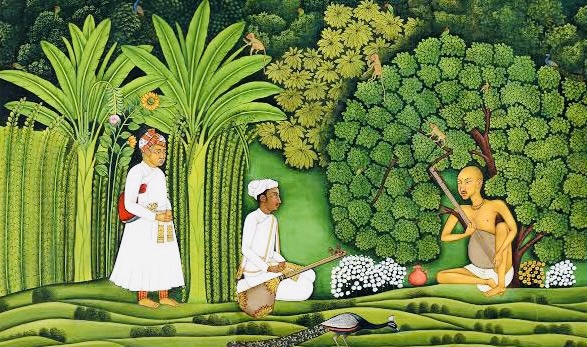
जीवन में गुरु की आवश्यकता हर किसी को होती है। यह एक शाश्वत सत्य है कि बिना गुरु के कोई भी व्यक्ति सत्पथ पर चलकर आत्मज्ञान या परम सत्य के आलोक को नहीं देख सकता।

गुरु केवल पथ प्रदर्शक नहीं होते वे स्वयं वह दीपक होते हैं, जिसकी रोशनी में साधक अपने भीतर के अंधकार को पहचानता है और उससे बाहर निकलने की यात्रा शुरू करता है।

आज के समाज में ‘ज्ञानी’ कहलाने की परिभाषा थोड़ी बदल गई है। ज्ञान का अर्थ अक्सर केवल तथ्यों और सूचनाओं का संग्रह मान लिया गया है। जो व्यक्ति उन्हें चतुराई से प्रस्तुत कर लेता है, उसे ही ‘ज्ञानी’ कहा जाता है।

पर क्या वास्तव में वह व्यक्ति ज्ञानी है? या वह केवल चतुर है?

गुरुपूर्णिमा के इस पावन अवसर पर आइए, इस भेद की थोड़ी खोज करें।

गुरुपूर्णिमा का दिन वही पुण्य तिथि है जब भगवान बुद्ध ने अपना प्रथम उपदेश धर्मचक्र प्रवर्तन पाँच शिष्यों को दिया था। यह केवल एक शिक्षण घटना नहीं थी, बल्कि आत्मज्ञान की एक वैश्विक धारा की शुरुआत थी।
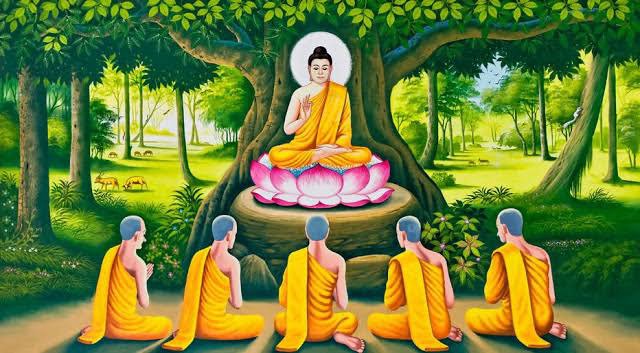
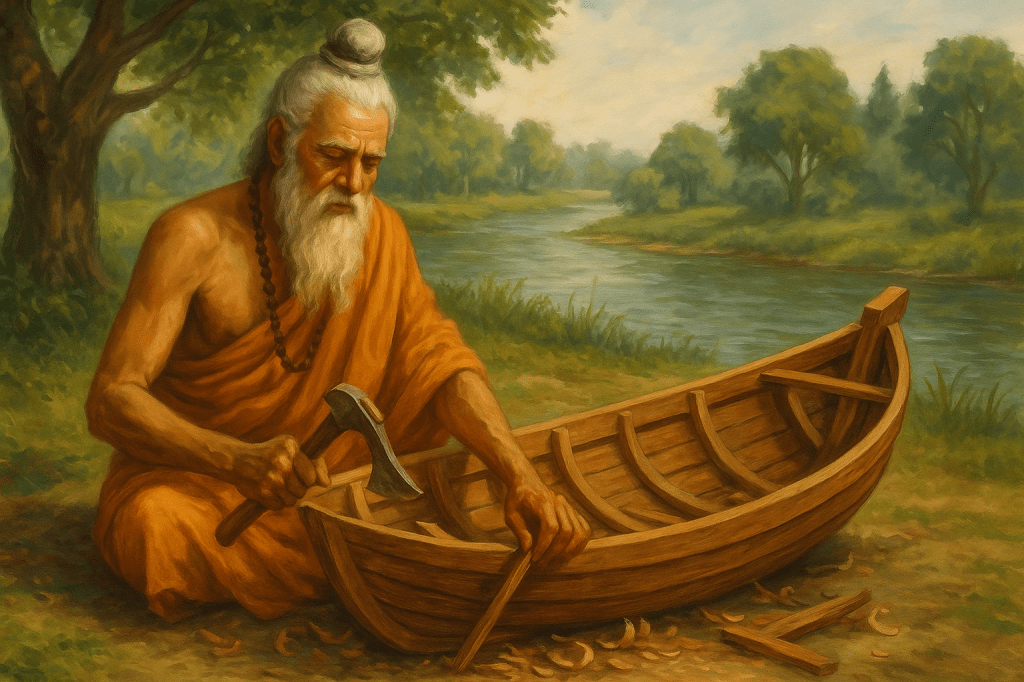
बुद्ध की एक कथा है, वे एक मुनि से बहती नदी के किनारे संवाद करते हैं।

बुद्ध पूछते हैं, “यदि कोई इस नदी के दूसरे किनारे जाना चाहे तो क्या करेगा?”

मुनि उत्तर देते हैं, “यदि जल कम हो तो वह पैदल पार कर सकता है; यदि गहरा हो, तो नाव का सहारा लेगा; और यदि तैरना आता हो तो स्वयं तैर सकता है।”

बुद्ध फिर प्रश्न करते हैं, “यदि वह न चलना चाहे, न तैरना, न नाव लेना, और यह कहे कि ‘नदी का दूसरा किनारा स्वयं चलकर मेरे पास आ जाए’ तो आप क्या कहेंगे?”

मुनि उत्तर देते हैं, “ऐसे व्यक्ति को हम मूर्ख ही कहेंगे।”

बुद्ध समझाते हैं, “जो व्यक्ति स्वयं के अज्ञान और भ्रांति को दूर नहीं करता, वह भी उसी प्रकार मुक्ति के दूसरे छोर तक नहीं पहुँच सकता। चाहे वह पूजा करे, अनुष्ठान करे, व्रत रखे या नैतिक जीवन जिए वह केवल भ्रम के साथ उसी किनारे पर खड़ा रहेगा।”

गुरु का कार्य: दिशा देना, नाव नहीं बनाना

मनुष्य को यह दुर्लभ जीवन परम सत्य की खोज के लिए मिला है। और इस सत्य तक पहुँचने के लिए गुरु की आवश्यकता अनिवार्य है। गुरु मार्ग दिखाते हैं, पर चलना तो स्वयं को ही होता है।

गुरु की दृष्टि में सभी शिष्य समान होते हैं वह न जाति देखता है, न पद, न धन, न विद्या।

शिष्य को यह निर्णय स्वयं करना होता है कि वह उस मार्ग को कैसे पार करेगा किसी की बनाई नाव से या अपनी नाव बनाकर।यह निर्णय उसके प्रारब्ध, संकल्प, और कर्मों पर आधारित होता है।

कलाकार की दो यात्राएँ: परफ़ॉर्मर और गुरु

कलाकार दो प्रकार के हो सकते हैं, एक परफ़ॉर्मर, दूसरा गुरु।

दोनों एक ही गुरु से शिक्षा पाकर भी अलग-अलग दिशाओं में यात्रा करते हैं।

परफ़ॉर्मर अक्सर दूसरों की बनाई नाव में यात्रा करता है। उसे मंच, आयोजक, दर्शक, और प्रशंसा की आवश्यकता होती है।

वह भी किनारे तक पहुँच सकता है, पर उसका अनुभव मुख्यतः बाह्य होता है।

गुरु, अपनी नाव स्वयं बनाता है, स्वयं ही उसका नाविक बनता है।

वह अकेले उस गहरे जल को पार करता है, और जब पहुँचता है, तब दूसरों को भी मार्ग दिखाने लगता है, अपनी नाव से, अपने अनुभव से।

दोनों ही दूसरे किनारे तक पहुँच सकते हैं, लेकिन क्या दोनों की यात्रा की गहराई, भक्ति, त्याग और अनुभूति समान होती है?

क्या मुक्ति की अनुभूति सबके लिए एक जैसी होती है? यह प्रश्न आज भी हमारे भीतर उत्तर की प्रतीक्षा में है। गुरुपूर्णिमा के इस पावन अवसर पर आप सभी को मेरी ओर से हार्दिक शुभकामनाएँ। स्वस्थ रहें, साधना में रमें, और स्वयं अपना दीपक बनें।

“तमसो मा ज्योतिर्गमय।”

(अंधकार से प्रकाश की ओर चलो।)
The Importance of Discernment and Discipline in Learning Classical Music

By Mukund Dev Sahoo

Imagine giving a heart patient cancer medication, or prescribing stomach ache medicine for a dental patient! Would such an approach heal either person? We would call such a doctor ignorant, and perhaps the patient uneducated. This analogy highlights a simple truth: to heal a specific ailment, you need the appropriate treatment. Likewise, in music or any art form, an informed approach is essential. As a classical music teacher, I’ve observed this many times with my students how the knowledge I pass down from my gurus impacts them, and how they receive it. This article aims to explore this dynamic.

Just as a doctor diagnoses the problem before prescribing medication and outlines a time frame for healing, a guru assesses a student’s musical aptitude, maturity, and foundational knowledge. Based on this assessment, the guru designs the teaching process. A wise student follows the guru’s method, dedicating their energy to refining their skills. If a student is not inclined to discipline, the guru’s wisdom may not resonate with them. Much of this interaction depends on the student’s environment, atmosphere, and upbringing.

Let’s delve deeper into how this exchange works. Classical music is considered an auditory art, while dance is a visual one. Both require the practitioner to observe discipline. In auditory art, the discipline lies in knowing what to listen to and what to avoid. Similarly, in visual art, it’s about discerning what to watch and what not to. In today’s world, where screens mobile phones, in particular are everywhere, this distinction becomes crucial. Watching reels, for example, has become second nature to most people, but artists and students need to understand when it helps and when it doesn’t.

For an artist, the path of mastery involves renunciation and dedication. Most people live either in the past or the future, but an artist lives in the present and teaches society how to live in the moment. This is one of the greatest lessons of art: to fully experience and enjoy life, and to understand its meaning in real-time. Therefore, discipline is a necessary part of this journey. If one can adhere to it, they will rise above societal pressures and live a fulfilling, enriched life.

Returning to the analogy: just as a specific medicine is prescribed to cure an illness within a given time frame, in art, adhering to the time-tested guidance of a guru is crucial. As human beings, our thoughts and behaviors reflect what we constantly absorb. If we regularly engage with violent or disturbing content, it will manifest in our actions. In the same way, if we fill our minds with shallow or negative music, it will inevitably reflect in our own artistic expressions.

Recently, a friend of mine who resides abroad shared a story about his strict guru, who forbade him from listening to other artists during his training. Though it caused frustration initially, over time, he realized the value of this disciplined approach. Years later, he even wrote a popular book based on his guru’s teachings. In the past, such strictness was common, which is why the concept of “Gharana” (musical lineage) held so much importance. However, today, listening to Gharana-style singing seems like a distant dream because many have lost their sense of discipline. This is not the fault of students or teachers alone; societal changes have played a significant role.

Classical music, being an auditory art, is traditionally passed down through oral transmission what we call “Gurumukhi Vidya” (knowledge from the guru’s mouth). The purity of this form depends on faithfully following the guru’s instructions. Listening to other styles or traditions during the formative years of training may dilute the student’s own musical journey. The more one immerses in a particular tradition, the more assured their progress.

In Deva Vani Dhrupad Music tradition, there are five principles of discipline known as “Sadachaar” that guide the student toward maintaining musical purity and discovering their own unique expression. These principles are deeply embedded in the Deva Vani Dhrupad tradition, and following them ensures that a student upholds the integrity of their art while carving out a distinctive identity in today’s world.

The famous name of Tansen is well-known in the Indian classical Dhrupad Music tradition. Many singers aspire to become like him. I remember, back in 2011, when I visited my late friend Devdatt’s home near Pune, his father an avid classical music enthusiast blessed me with valuable advice. He said, “Many are trying to prove themselves as Tansen, but you, my son, strive to be a ‘Kansen’ (one who listens). Focus on listening carefully to your guru and your own voice during practice. Always be mindful of what music you expose yourself to, for it will shape your musical journey.” His words had a lasting impact on me and helped me develop a distinct musical style of my own.

Over the years, many students have come to learn from me some for a short time, some for longer. My only hope is that they gain something valuable from their training, something that impacts their lives and brings stability to their journey. In conclusion, I’d like to emphasize that art can transform your life, but only if you distance yourself from the distractions of easily accessible entertainment and instead focus on the teachings of your guru. Only then can you truly understand the depth of art and discover its beauty.

The Illusion of Light

By Mukund Dev Sahoo

We often believe that the light from a lamp can illuminate us, but this is merely an illusion. Our physical body, formed from the five elements (Pancha Bhuta), is driven by the subtle body (mind), which is in turn veiled by various thought patterns. Through this cycle, we engage in actions driven by a constant pursuit of happiness, wealth, and recognition. Among all humanity, only a fraction perhaps less than one percent are truly searching for liberation.

On this path of seeking, many look for miracles and often search for a crutch to lean on. The irony is that they seek this support in another human being, just like themselves, believing that person’s words to be absolute truth. They go so far as to worship these individuals, treating them as the key to their salvation.

Throughout history, countless great souls have walked this Earth. But how many of their followers truly became like them? Perhaps a small percentage, out of hundreds, were influenced by their wisdom and became their devoted disciples. No matter who the great soul is, there will always be those who criticize or oppose their teachings. Does this mean that following the path shown by these enlightened beings is a mistake?

Every human is endowed with unique intelligence and reasoning power, which allows them to chart their own path. Yes, we should certainly study and listen to the teachings of great masters, but the key is to analyze and discover our own way forward, using our intellect and critical thinking.

True liberation can only be achieved through our own earned merits, shaped by the karmas (actions) from our past. Our fate the circumstances we face today is determined by the virtues we accumulated in the past. This virtue paves the way to our liberation, and it is a path we must discover ourselves. Following a guru or master is not wrong, but unless we remain centered on our own path, liberation will remain elusive.

Let’s illustrate this with a simple example: Have you ever closely observed a lamp? When it burns, its flame casts light into the surrounding darkness a fact we are all aware of. The light becomes a focal point, attracting many towards it. The lamp burns with the help of oil, a wick, and a structure made of clay or brass, and it continues to emit light until its fuel is exhausted.

Similarly, many great souls have illuminated the paths of countless individuals with their wisdom. However, if we observe carefully, we’ll notice that along with the flame, there is always smoke. Wherever the smoke touches, it leaves a blackened trace. This means that, in addition to the light, the lamp also emits a shadow of darkness. The problem is that we have not trained our eyes to see this dark side.

Looking through the pages of history, we can find that even the lives of great masters had moments where a dark cloud appeared, a shadow rose. The lamp emits both light and shadow. Therefore, the wise approach is to light a lamp within yourself, one that produces no dark smoke. Light a lamp that brings warmth without burning, one that provides coolness and calm yet still radiates light.

Be that Lamp. Become that Light.

In conclusion, each of us should strive to be a lamp that burns steadily without causing harm, radiating light that is soothing yet bright. Instead of relying solely on external sources of light, we must cultivate the ability to shine from within, embodying both wisdom and compassion. Be the lamp that guides without leaving behind a trail of smoke – be the light you seek in the world.

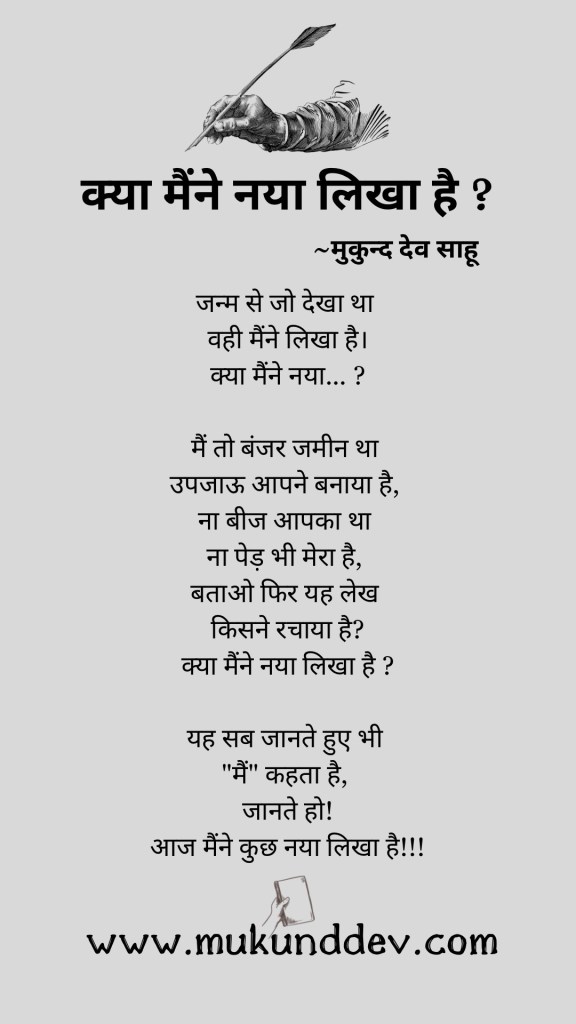
क्या मैंने नया लिखा है ?

~मुकुन्ददेव साहू

जन्म से जो देखा था
वही मैंने लिखा है।
क्या मैंने नया… ?

मैं तो बंजर जमीन था
उपजाऊ आपने बनाया है,
ना बीज आपका था
ना पेड़ भी मेरा है,
बताओ फिर यह लेख
किसने रचाया है?
क्या मैंने नया लिखा है ?

यह सब जानते हुए भी
“मैं” कहता है,
जानते हो!
आज मैंने कुछ नया लिखा है!!!

Translation

Have I written something new?

What I’ve seen since birth,
That’s what I’ve penned. Have I written something new?

I was a barren land,
Fertile, you’ve made me,
Neither the seed was yours,
Nor the tree mine,
Then tell me, this writing,
Who has composed it?
Have I written something new?

Knowing everything,
“I” still says,
You know!
Today, I’ve written something new!

Have I written something new?

Should a music student blindly accept the words of a Satguru? Can knowledge emerge from this?

By Mukund Dev Sahoo

The most important and yet, the most difficult task is to educate someone. Transmission of knowledge between the teacher and the taught, depends on a teacher’s intellectual development and level of communication, and the receptivity of a student. In essence, an effective teacher brings out the best from within a student.

Being a music teacher for long, I am interested to share with you all, a few of my observations and thoughts. For the past several years, many students have come to me for learning. They all have one thing in common in their mind: if what they are singing is right or wrong, and why are they not able to understand? How do they make mistakes even after I tell them, how to envision the place of a shruti in the interval of swaras used in a raga? They become disturbed because of this, get upset as to why they are unable to understand all these nuances of music? Due to which many have stopped learning music. Furthermore, if Shadaj (Sa) means Shat+Aj; Shat means six and Aj means originating, i.e., the six Swaras originate from Sa itself, then why are they not realising it?

It seems to me that many of today’s music students would similarly be troubled with all these doubts! I am writing this article to address, “why do these doubts arise?” This article is to bring clarity to these doubts and how one should imbibe the best that the art forms offer, in essence, the (He)art of music.

I think it would be appropriate to share here an incident that happened to me, probably in the year 1995, when I was 7 years of age. Our family was raised in Vaishnavism and my father used to perform kirtan, walking the streets, singing the name of Krishna and playing the mridangam (Khol). Whenever he met a saint on the way, father used to invite him for a meal at home. One day father came home with a monk who was wearing saffron robe and had a coiffure on his head. When that monk saw me, he put his hand on my head and gave me a photo in my hand which had a picture of a saint. The monk also gave a mantra to chant and said, “Whenever you have any problem in life, remember him, close your eyes and take his name, all your problems will go away.” After that day, this mantra was included in my Sandhya Aarti which consisted of – Gayatri Mantra, Mahamrityunjaya Mantra, Sandhya Mantra, Navagraha Mantra; at the end of chanting all these mantras, I used to chant the mantra which the monk gave. I didn’t know who this saint was, what he did, or where he was from, I didn’t know anything about the saint in the photo. Yet, I just chanted his name in the mantra everyday as was instructed to me by the monk.

In 2018, my Guruji Padmashree Gundecha Bandhu’s father, Late Shri Chandmal Gundecha Ji, from whom I learned many important things in life, was reading a book at his home. I used to go to Guru ji’s house every day, that day also when I went there, seeing the book Babu ji was reading, I asked him, “What is that book you are reading?” He said, “This is the book of Saint Mahatmas.” “Please can I see it?” I asked. Babu ji said, “Do you want to see or read, tell me?” “I want to read this book after seeing it” I said. Then he gave me that book. When I opened the book, I saw that the same photo which was given to me by the monk in 1995 was inside this book and the whole journey of the saint’s life was written there. When I saw all this in the book, I was surprised that the saint, whose name I was chanting for so many years, though I never showed any desire to know about him; yet he came in front of me and told me who he was!

I have a deep feeling that we may not understand some of the things that Sat Guru (Master, Saint) says now, but if we practise what is said every day, even if it is without understanding, when the time comes, the same thing will be understood. I do not mean to say that you must do things without understanding; if you are able to understand, then that is good; you should try your best to understand. However, if you do not understand, there is no problem in that, just keep doing the Sadhana. It will reflect and dawn in your understanding when the right time comes. Perhaps this birth may also fall short of this understanding, just as following evening is night, and as the sun rises it is morning; this cycle of nature is not dependent on anyone, it is rotating freely in time. If you go to the temple in the dark of the night and pray for morning to dawn in the middle of the night, then even God will call you mad. Similarly, true knowledge automatically dawns, moving in the cycle of time. That knowledge will surely be a payoff when you are ready and have matured. Do not expect that knowledge would just happen because of a sadhna; even if you feel that you are getting peace of mind (& soul) by the music sadhna, then just keep doing the sadhna and keep walking on this path.

I could not understand many things that we learned from Guruji Padmashree Gundecha Bandhu ji then; only now slowly I’m understanding and realising what he wanted to convey. We are all familiar with the fact that music is Gandharva kala. But what is the meaning of Gandharva? The art which brings the sense of infinity, which can take one to samadhi and whose practice opens the door to salvation, is Gandharva art. Cultivation of such an art is not in everyone’s destiny; if you are joining this practice, then you must have done very good deeds by which you are getting familiar with the heart of this art. Keep with music sadhana, treading the path constantly, continuously and in full receptivity to what is taught! All that is to be understood will reveal itself with readiness of the mind!

For any query please contact: E-mail dhrupadmusicfoundation@gmail.com http://www.mukunddev.com http://www.dhrupadmusicfoundation.com

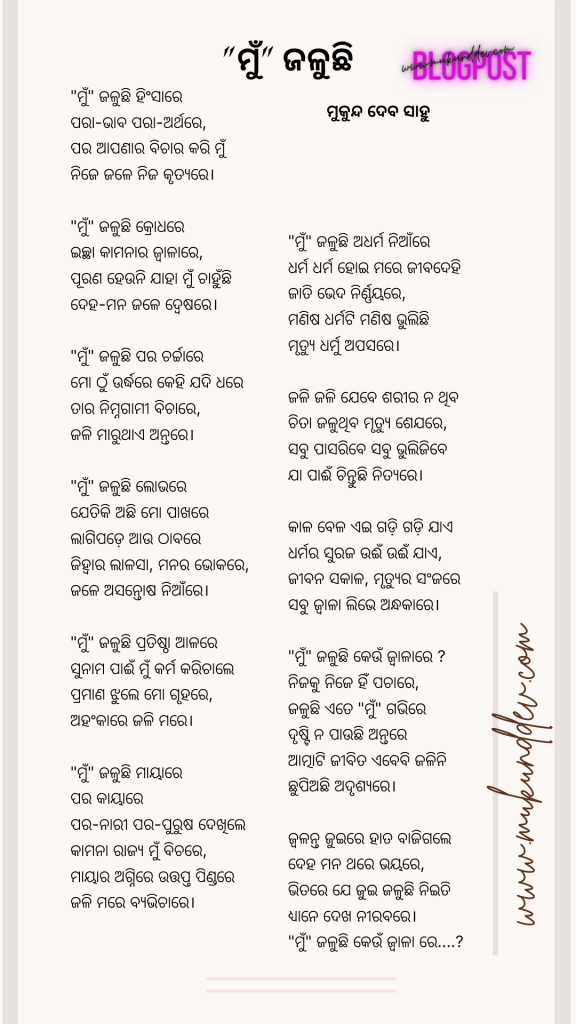
“I” AM BURNING

Mukund Dev Sahoo

(This poem is originally an Odia poem written by Mukunda Dev.)


“I” am burning with violence,
with the sense of alienation and the wealth of others,
with the feeling of alienation and my own,
I am burning in my own actions.

“I” am burning with anger,
my body and mind are burning with hatred because of the non-fulfillment of my desire.

“I” am burning in the discussion of others, If someone is rising above me, then I have been thinking for his lower, And I burn with my inner fire.

“I” am burning with greed,
Not satisfied with what I have,
I am looking for more,
burning with the fire of dissatisfaction with the longing of the tongue and the hunger of the mind.

“I” do my work with a desire to get a good reputation and satisfy my ego and I have kept the certificate of good fortune hanging in my physical house.
And I am burning with ego.

“I” am burning with Maya and seeing other women and men from the bodies of others,
I burn with the flame of desire.
By burning my body with the fire of Maya,
I am burning with adultery.

“I” am burning with the fire of religion,
due to the difference of religion,
I divided man into human beings and forgot that death is the last religion.

When the body will no longer be burnt,
when I sleep on the bed of death by the fire of the pyre,
then all will be forgotten for whom I always worry.

The wheel of time goes on turning,
the sun of righteousness comes and goes, in the morning of life,
in the evening of death, all the flames will disappear into darkness.

What flame am I burning?
Let me see once from my own intuition,
“I” am burning so much from inside that my sight is not reaching there but the soul is still not burnt which is invisible from me.

When the hand is involved in the burning fire, then the whole body and mind trembles,
to see the fire which is burning from inside,
it needs silent and constant meditation.
Then you will know in which flame “I” am burning.

Jealousy, Hatred, Anger and Sadhana

Hatred:

It was in 2002, when I started learning music properly, there was a music competition in Math(Ashram) near our house in Chandneshwar. Both my brothers gave me a lot of enthusiasm to participate in this competition and I also agreed. For the first time in my life, I was participating in the competition and When I got on the stage, I started trembling with fear and for the first time I started holding the mike in my hand, then my hand started trembling, throat started trembling and when I started singing, when it ended, I didn’t know anything. After the end of my singing, I could hear that one or two people were compulsively clapping! Came back home very sad that night and I banged my head on the harmonium and started talking with him. The next morning an incident happened due to which I am able to feel the depths of music today. Supply water used to come right in front of our house and the whole village used to gather there to fill that supply water, the next morning all the villages had reached there to fill water And started talking about my singing last night, among all those people a man named Bapi da was mocking me and making fun of me in front of everyone, Bapi was showing everyone in a dramatic way like I was trembling while singing! I was watching and listening to all this sitting in my house, tears were flowing from my eyes and there was a lot of hatred on Bapi, I used to meet with him almost every day in the village and whenever I saw him, I was filled with hatred and I had made sure in my heart that I should show him one day by singing a song. Today that hatred has turned into gratitude. I express my gratitude to him from the bottom of my heart. If he had not insulted me that day, perhaps I would not have understood the infinite ocean of Music.

This story of mine is said because while doing music, many people will meet who will applaud, they will speak good but those who speak bad should be given gratitude because the same people want your well-being. The feeling of hatred for the people who call you bad will come in the initial stage, it is necessary to save it, if you express it, then the energies of your sadhana will be reduced.

Anger:


I had taken admission in Mumbai University in 2011-12 to do M.Mus and stayed in JS Hall Hostel in Churchgate, Mumbai. I made a lot of friends in the music department of the university. Jazim Sharma is one of those friends, who is famous today in the name of well-known Ghazal Singers across the world. Jazim used to live in a separate room in the hostel but whenever I am sitting to do my Sadhana, he used to come to my room and snatch the harmonium from me and start singing his ghazals and also ask me to sing as well But the technique of ghazal did not come down in my throat, still I used to try and jazim taunting me, Tere Se Ghazal Nahi Banega always used to speak. Whenever he used to say this, I used to get very angry with him. I used to stop my classical music practice and try singing ghazals just to show him But despite my best efforts, the ghazal was not sung till the very end And I used to get very sad about this. Some friends and I used to wrestle every evening in the style of WWE!! For that wrestling I used to get alone and Jazim on the other side and some friends. Our hard-hitting friend Late Devdutt Kulkarni used to play the role of referee. This wrestling was the only opportunity that used to cool my anger on Jazim!
I told this story of mine here because I have seen that if our aim in sadhana is not very strong then we can get influenced by anyone who can destroy, corrupt our sadhana and we go astray. We should follow the music of our soul, not try to connect our path with the rhythm of others. Like I did during my M.Mus, Ghazal was not my subject, Classical Music was the subject on which I had to stick, but due to ignorance, I lost my purpose. The subject which is not ours, by listening to someone, seeing or being influenced by someone’s words, when we try to study on that subject, then two things can happen, one we can do that thing well, otherwise because of not being proficient on that subject, we keep on burning with anger or we can get frustrated.

Jealousy:


“Jealousy is never a sign of purity, it only burns those who are jealous to ashes.”

In 2005/6, when I had enrolled in Utkal Sangeet Mahavidyalaya Bhubaneswar, my aim was absolutely sure. For the whole 5 years, I woke up every day at 4:00 am and continued to do my spiritual practice which is the sanskar of my late father. Seeing my waking up in the morning, some of my friends used to try to get up at 4:00 am to do sadhna and they used to sit beside me and used to play harmonium on a different scale but I didn’t get any effect from them. When all of them used to do this, my attention became more firm, I used to try to listen to my voices more carefully. Their jealousy was helpful in my sadhana because my aim was only in doing sadhna, just like a thirsty person needs water. I got the opportunity to stay in the shelter of great gurus in my musical journey, I have seen many disciples of those gurus having strong jealousy from each other. If a disciple of a guru is doing a very good job, then only the disciples of the same guru get burnt by the fire of jealousy, we have also seen this. Jealousy is never a sign of purity, it only burns those who are jealous to ashes.

We should also keep in mind that music is not tied to any other person, music is free like the sky, music binds everyone with one sound, music is the father of all individuals and creation. In the initial practice stage of music, one can be centered, but as you sink into the continuum of cultivation, the music will shine like a ray of sunshine.

Knowledge unfolds by itself

A calf of a cow is born and goes to its mother and starts drinking milk on its own. Mother never taught him or never showed him how to drink milk but he went and started drinking on his own, neither he did chanting nor Tapa nor did he take the help of other people.

We humans only say that we humans are the greatest scholars, the most knowledgeable, the most great. And we also need the most security, from everybody. And we are great. Whatever we are chanting, someone made it, we did not even see it and someone told us that this chanting will help us to cross the river, We humans are so innocent that we accept everyone’s words very easily without any insight.

Till the last breath, see what the truth is, how it is, how it rises and how it goes. Have taken help without anyone without being influenced by some outside influence. Your own knowledge is illuminated like the sun. Wait for the same morning when the sun will be on its own and sit all night till the sun comes. In this night of ignorance, the eyelids of many are closed and the sun of supreme knowledge shines in those whose eyes are open.