माँ – सबका आदर्श

At the age of 35, life took a turn, defining a new role as a father. With age, friendships shifted, younger connections fading as older bonds strengthened. The journey of aging brought a profound realization. Memories of childhood, learning alongside the stove where meals were cooked, studying in the dim light of kerosene lamps, marked the early days.

Every mother is unique, each holding stories untold. Today, the essence of motherhood seems lost in societal shifts. Remembering moments of struggle and perseverance, these stories of resilience must be shared, especially in a world where young mothers often feel lost in insecurities.

The upbringing shaped by a mother’s grit became a foundation for navigating life’s challenges. Witnessing her dedication despite hardships, the essence of her character remained unbroken. As in our culture, where the soil and the plants grow intertwined, she nurtured us with unwavering love.

Observing today’s mothers, the speaker laments the societal pressures overshadowing the essence of motherhood. The emphasis on empowering women is commendable, yet it’s crucial to recognize the innate responsibility a mother carries in shaping her children’s lives, a divine duty bestowed upon her by nature.

As society champions women’s empowerment, it’s equally vital to revere and uphold the role of mothers, acknowledging their irreplaceable significance in sculpting the future generation.
Why “Dhrupad” Margi Sangeet ?

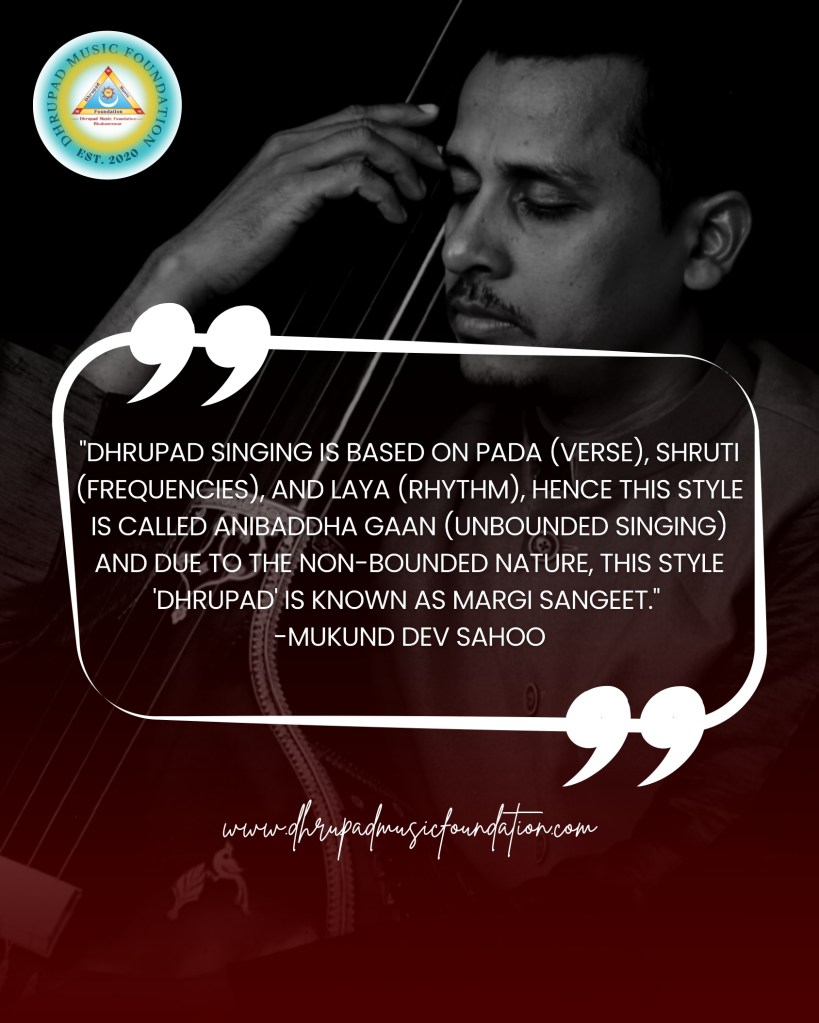
“Dhrupad singing is based on Pada (Verse), Shruti (Frequencies), and Laya (Rhythm), hence this style is called Anibaddha gaan (unbounded singing) and due to the non-bounded nature, this style ‘Dhrupad’ is known as Margi Sangeet.” -Mukund Dev Sahoo

Question: why is it just dhrupad singing? And Not all classical singing? Aren’t they similarly based on verse, shruti & laya?

“In other styles of music, the foundation rests upon Tala and Swara, which form the primary bond. However, Margi Sangeet sets a unique goal to attain the Naad Vindu by diligently following Shruti and Laya, not solely Swar and Tala. While Tala and Swars can be likened to adorning oneself with clothing, Shruti and Laya are akin to the unadorned body and soul, representing a deeper, unadulterated connection to the essence of pure sound.”

खाली कुर्सी

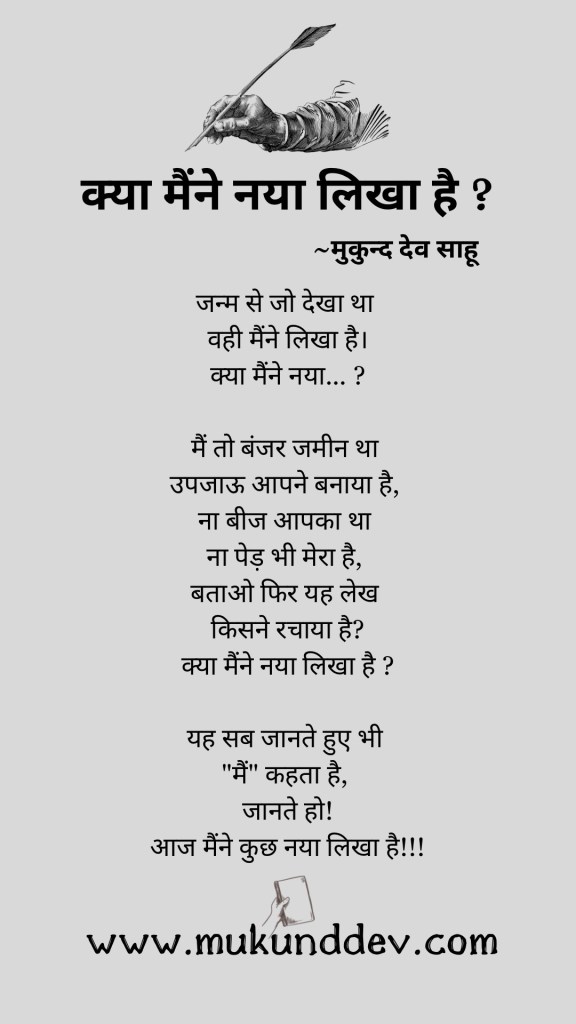
खाली कुर्सी
जिसको मैंने अपनाया है,
जीवित रहते हुए मृत बन
उसके नीचे स्वयं को दफनाया है…
खाली कुर्सी
जिसको मैंने अपनाया है….

ख्वाबों की नगरी में
इसी कुर्सी को
माया के रंगों से सजाया है….
खाली कुर्सी
जिसको मैंने अपनाया है…..

कितने उसपर बैठे
फिर भी खुदको खाली पाया है…।।
खाली कुर्सी…..

Should a music student blindly accept the words of a Satguru? Can knowledge emerge from this?

By Mukund Dev Sahoo

The most important and yet, the most difficult task is to educate someone. Transmission of knowledge between the teacher and the taught, depends on a teacher’s intellectual development and level of communication, and the receptivity of a student. In essence, an effective teacher brings out the best from within a student.

Being a music teacher for long, I am interested to share with you all, a few of my observations and thoughts. For the past several years, many students have come to me for learning. They all have one thing in common in their mind: if what they are singing is right or wrong, and why are they not able to understand? How do they make mistakes even after I tell them, how to envision the place of a shruti in the interval of swaras used in a raga? They become disturbed because of this, get upset as to why they are unable to understand all these nuances of music? Due to which many have stopped learning music. Furthermore, if Shadaj (Sa) means Shat+Aj; Shat means six and Aj means originating, i.e., the six Swaras originate from Sa itself, then why are they not realising it?

It seems to me that many of today’s music students would similarly be troubled with all these doubts! I am writing this article to address, “why do these doubts arise?” This article is to bring clarity to these doubts and how one should imbibe the best that the art forms offer, in essence, the (He)art of music.

I think it would be appropriate to share here an incident that happened to me, probably in the year 1995, when I was 7 years of age. Our family was raised in Vaishnavism and my father used to perform kirtan, walking the streets, singing the name of Krishna and playing the mridangam (Khol). Whenever he met a saint on the way, father used to invite him for a meal at home. One day father came home with a monk who was wearing saffron robe and had a coiffure on his head. When that monk saw me, he put his hand on my head and gave me a photo in my hand which had a picture of a saint. The monk also gave a mantra to chant and said, “Whenever you have any problem in life, remember him, close your eyes and take his name, all your problems will go away.” After that day, this mantra was included in my Sandhya Aarti which consisted of – Gayatri Mantra, Mahamrityunjaya Mantra, Sandhya Mantra, Navagraha Mantra; at the end of chanting all these mantras, I used to chant the mantra which the monk gave. I didn’t know who this saint was, what he did, or where he was from, I didn’t know anything about the saint in the photo. Yet, I just chanted his name in the mantra everyday as was instructed to me by the monk.

In 2018, my Guruji Padmashree Gundecha Bandhu’s father, Late Shri Chandmal Gundecha Ji, from whom I learned many important things in life, was reading a book at his home. I used to go to Guru ji’s house every day, that day also when I went there, seeing the book Babu ji was reading, I asked him, “What is that book you are reading?” He said, “This is the book of Saint Mahatmas.” “Please can I see it?” I asked. Babu ji said, “Do you want to see or read, tell me?” “I want to read this book after seeing it” I said. Then he gave me that book. When I opened the book, I saw that the same photo which was given to me by the monk in 1995 was inside this book and the whole journey of the saint’s life was written there. When I saw all this in the book, I was surprised that the saint, whose name I was chanting for so many years, though I never showed any desire to know about him; yet he came in front of me and told me who he was!

I have a deep feeling that we may not understand some of the things that Sat Guru (Master, Saint) says now, but if we practise what is said every day, even if it is without understanding, when the time comes, the same thing will be understood. I do not mean to say that you must do things without understanding; if you are able to understand, then that is good; you should try your best to understand. However, if you do not understand, there is no problem in that, just keep doing the Sadhana. It will reflect and dawn in your understanding when the right time comes. Perhaps this birth may also fall short of this understanding, just as following evening is night, and as the sun rises it is morning; this cycle of nature is not dependent on anyone, it is rotating freely in time. If you go to the temple in the dark of the night and pray for morning to dawn in the middle of the night, then even God will call you mad. Similarly, true knowledge automatically dawns, moving in the cycle of time. That knowledge will surely be a payoff when you are ready and have matured. Do not expect that knowledge would just happen because of a sadhna; even if you feel that you are getting peace of mind (& soul) by the music sadhna, then just keep doing the sadhna and keep walking on this path.

I could not understand many things that we learned from Guruji Padmashree Gundecha Bandhu ji then; only now slowly I’m understanding and realising what he wanted to convey. We are all familiar with the fact that music is Gandharva kala. But what is the meaning of Gandharva? The art which brings the sense of infinity, which can take one to samadhi and whose practice opens the door to salvation, is Gandharva art. Cultivation of such an art is not in everyone’s destiny; if you are joining this practice, then you must have done very good deeds by which you are getting familiar with the heart of this art. Keep with music sadhana, treading the path constantly, continuously and in full receptivity to what is taught! All that is to be understood will reveal itself with readiness of the mind!

For any query please contact: E-mail dhrupadmusicfoundation@gmail.com http://www.mukunddev.com http://www.dhrupadmusicfoundation.com

The condition of classical music and musicians in Odisha is appalling.


The demise of Pandit Umesh Chandra Kar has filled my heart with immense pain. Pandit ji is a very famous name in the history of Tabla of Odisha. He is probably not known to many people in India because he is from Odisha. This is not due to limitations of other states, it is because of the limitations of Odisha’s musical environment; odisa’s political scene was unable to recognize his art and artistic talents. Panditji could definitely have been recommended for the Padma award or any other national award, if not for Odisha’s political scene. If he hailed from any other states of India, his name would have been nominated for Padma award and would have been given a chance to present his art in every major program held at the government level in India. The music world of Orissa has not learned to promote anything other than Odissi music and Odissi dance and appreciate any artist or their art. It is not that artists are not being prepared in Odisha, every year hundreds of students pass out from Utkal Sangeet Mahavidyalaya and Utkal University of Culture, but where do all these artists go? There is very little appreciation of art here so where do these art students go? What do they do? There is no trace of them in the field of art.

Today again a great personality who created many disciples in Odisha music history disappeared into the sky, not much known to the outside, even within india. One of my disciples went to him just a few days ago. When he said that he is learning Dhrupad, Pandit ji said that this Dhrupad music is the root of all music, I am very happy you are learning it. Then Pandit ji said to the student,
“I have played my tabla with so many great personalities, I’m requesting you tell all this to the government so that they can give way to my art.” When that student came and told me this, I was very distressed. You can guess from this how much pain and suffering he was in, in his last stage of life.

Pandit Ji belongs to a strong musical family, his father Pandit Khetramohan Kar was a well-known tabla player and many artists of India used to visit his house in Puri. Even after belonging to such a strong musical family, his sorrow and pain was immense as he was born in Odisha. This experience of my 12 years living outside Odisha to learn music says that if he had lived in cities like Kolkata, Pune, Mumbai, Delhi, Punjab etc he might not have had to face this pain and suffering. Great artistes like Vidushi Sunanda Patnaik had moved to Kolkata because of such indicative musical atmosphere of Orissa.

I heartily request all the music gurus, music critics, music lovers and politicians of Odisha to designate a road in his name to keep Panditji’s memory alive and place Pandit Umesh Chandra Kar statue in that road. This cannot complete the irreparable loss in classical music, but if this is done, then Pandit ji’s soul can definitely find peace, I believe.

Mukunda Dev Sahoo

Dhrupad exponent, (Disciple of Padma Shri Gundecha Brothers) Poet, Writter & Composer

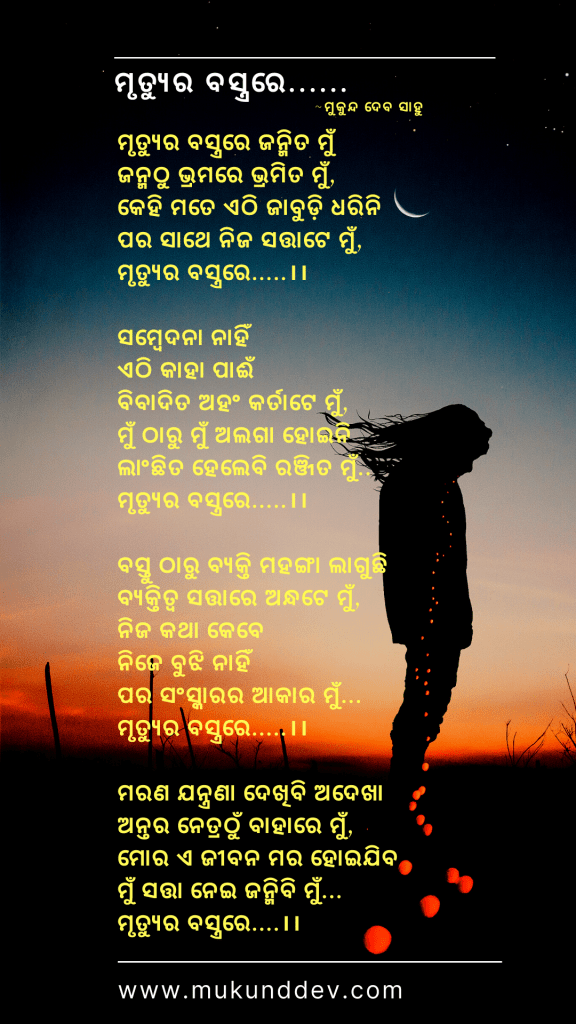
“I”(Ego) is born in the garb of death

By Mukund dev

“I” have taken birth wearing the garb of death,
and from birth “I” have been delusional,
No one is sitting here holding me
I (Ego) just an entity with others.
“I”(Ego) In the garb of death…

Feelings are not for anyone
“I” is a disputed doer,
“I” have never been separated from “I”,
even though I am stigmatized,
“I” is happy.
“I”(Ego) In the garb of death….

A person seems more expensive than a commodity
and a person is blind to the power of his personality of “I”,
“I” have never understood my own point of view,
“I” is a shape of the culture of others.
“I”(Ego) In the garb of death….

Seeing the pain of death, the “I” ignores it
Only the “I” is a deterrent to the awakening of insight,
This life of mine will die then “I” will be born with the “I” being.
“I”(Ego) In the garb of death….